Building Momentum for Community Media
WHCA joins unprecedented statewide effort to modernize community media funding in Massachusetts
Community media organizations across Massachusetts recently came together in one of the largest coordinated advocacy efforts our industry has ever seen, working to modernize the funding model that supports local government transparency, educational programming, and community media.
Although the House effort did not ultimately produce the result we had hoped for, the campaign generated overwhelming bipartisan support, strengthened relationships with legislators across the Commonwealth, and demonstrated what can be accomplished when local community media organizations work together toward a common goal.
WHCA was proud to participate in that effort, both locally and statewide.
For decades, Massachusetts community media organizations have relied almost exclusively on cable television franchise fees to fund local programming, government meeting coverage, educational content, and community-produced media. As more households transition from traditional cable television to streaming services, that funding model continues to decline despite increasing demand for local, transparent, and accessible media.
To address that challenge, community media organizations have worked together over several legislative sessions to modernize the funding model by extending the existing right-of-way fee structure to streaming providers. Earlier versions of this effort were introduced through H.91 and S.41, with the Senate bill later advancing as S.2556. During the current legislative session, modernization language was also pursued through House Amendment #678 to H.5562, the House Economic Development Bill, and through Senate Amendment #127 to S.3178, together with related Senate Amendment #360 addressing municipal revolving funds.
A Remarkable Statewide Effort
MassAccess coordinated a statewide advocacy campaign that brought together community media organizations from across the Commonwealth. Staff, volunteers, board members, municipal officials, and residents all worked together to educate legislators about the importance of community media and encourage support for modernization.
The response was extraordinary.
House Amendment #678 ultimately attracted public support from 118 of the Massachusetts House’s 141 Representatives, representing overwhelming bipartisan support from communities across the Commonwealth.
The amendment was initially included within a consolidated package considered by the House. However, shortly before the final vote, it was removed from that package and was therefore not included in the version of the Economic Development Bill passed by the House. While disappointing, the campaign demonstrated unprecedented legislative support for community media modernization and created a strong foundation for continued advocacy.
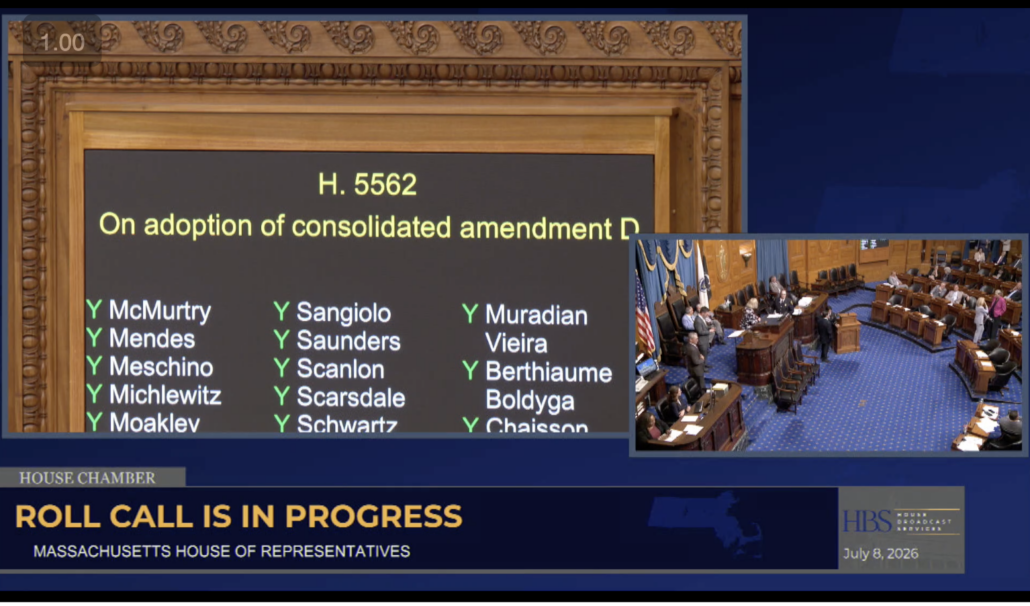
House debate on H.5562 during consideration of Consolidated Amendment D. (hyperlinked via the above image). Although the community media language was ultimately removed before final passage, the campaign generated unprecedented bipartisan support and statewide collaboration.
WHCA’s Participation
WHCA was proud to play an active role throughout the effort.
Earlier in the process, the Whitman Select Board unanimously adopted a formal resolution supporting modernization of community media funding.
WHCA also contacted its full House delegation, resulting in support from all three State Representatives serving Whitman and Hanson. As attention shifted to the Senate, WHCA encouraged residents to contact their State Senators while continuing to share educational resources through our website and social media, including an excellent advocacy video produced by our colleagues a Athol-Orange Community Television explaining why modernization matters.
Behind the scenes, WHCA also contributed to the statewide coordination effort. During the House campaign, Executive Director Eric Dresser developed an AI-assisted legislative outreach resource identifying priority legislators who had not yet publicly committed their support. The resource was quickly adopted and distributed statewide through MassAccess, helping community media organizations focus their remaining outreach efforts during the final days before House debate.
That work has since grown into development of a shared Member-Legislator Relationship Database, intended to preserve legislative relationships, outreach history, and institutional knowledge for future advocacy efforts rather than rebuilding those efforts from scratch each legislative session.
Looking Ahead
Although the House amendment did not ultimately become part of the House version of the Economic Development Bill, the broader legislative effort to modernize community media funding continues.
Following House action, advocates shifted their attention to the Senate while continuing to build support for modernization language. In addition, recent changes to the Massachusetts legislative rules have created additional opportunities for certain bills to continue moving during the informal legislative session before the new legislative session begins in January. As MassAccess noted following the close of formal session, the underlying community media legislation remains technically alive, even though the path forward becomes more challenging.
Regardless of the ultimate outcome of this legislative session, something important has already been accomplished.
Community media organizations across Massachusetts worked together in an unprecedented way. Relationships were built. Municipal leaders, legislators, volunteers, and residents became more engaged in the conversation. Perhaps most importantly, broad bipartisan support demonstrated that sustaining local community media is an issue that resonates well beyond our own industry.
WHCA remains committed to supporting these efforts, both locally and statewide, while continuing to serve the residents of Whitman and Hanson through transparent, locally focused community media.
